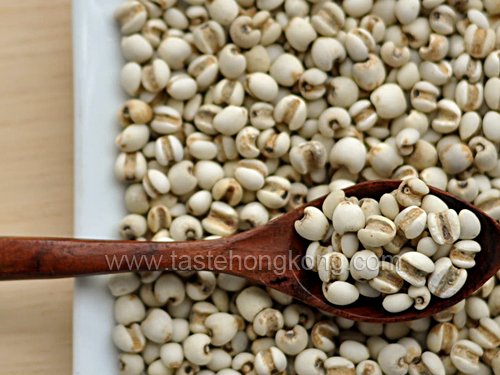
Ingredient: Job’s Tears aka Coix Seeds

Job's Tears aka Coix Seeds

Though Job’s Tears sometimes has been nicknamed as Chinese pearl barley, it is not a type of barley as you shall see in a picture below.

There are sayings that coix seed is called ‘Job’s Tears’ because of the biblical Job of the Old Testament, who frequently tears from the sufferings he endured. In Latin, no wonder why it is named Coix-lachryma-jobi, literally Job’s Tears. Less mythical probably is its name in Chinese, yì rén / yì mí (薏仁 / 薏米), having the meaning of small grains.

Among Chinese, coix seed has been valued for its ‘cooling’ property, a concept related to Chinese food therapy, for acting on an ‘inflammed’ human body, mostly occurred after taking considerable spicy, grilled or barbecued foods. In addition to this, Chinese herbalists have regarded the seeds as being capable of:
- enhancing immunity
- inducing diuresis,
- excreting dampness,
- strengthening spleen,
However, they suggest that it is not suitable for pregnant women. But there are claims mention that coix is good for nourishing the skin making it look soft and smooth. Click here and here for two more readings from Encyclopedia of Alternative Medicine and Acupuncturetoday.com.

Job’s Tears and Pearl Barley
If you come across something that looks very similar to pearl barley – spherical in shape, pearl in color, having a brownish groove on one side, but is about twice the size of it, then it is probably coix seeds. Yet it is better to clarify before you pay because I have seen Job’s tears being labeled as pearl barley (wrong in English but correct in Chinese!). Anyway thankful to them for being part of my inspirations for putting up this post.
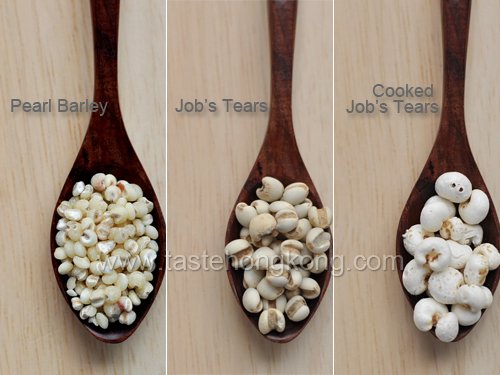
Raw and Cooked Job's Tears vs Pearl Barley

Two Kinds of Job’s Tears
In Asian grocery stores, Chinese ones in particular, you shall be able to find both raw and cooked Job Tears. The cooked one is not meant to be eaten immediately but is fried to have its property turned from cool to warm after which it is usually use for balancing the cool property of raw Job Tears. So doing, for example, a soup containing the Job tears will better suit the whole family as the body condition of each individual varies (again it is part of the concept of Chinese food therapy).

Cooking Job’s Tears
The simpliest way of enjoying Job’s Tears to me is to cook it into a drink, served hot or chilled and seasoned with sugar or honey, which is then the popular yì mí shǔi (薏米水) in Chinese or Job’s Tears Water – if I have to give it a name in English. By adding a tea spoon of fresh lemon juice, it is another hit way of savoring the drink. Before boiling the raw Job’s Tears, just rinse it and soak it in water for about an hour. Then boil with the same water for an hour (seed:water is about 1:20 but half it to 1:10 for soaking). While drinking the Job’s Tears Water, try also swallow the boiled seeds before strain it away as most people do. It is somewhat like eating cooked rice with a firmer core.

Cooked Job’s Tears
Cooked Job’s tears is feather-like in weight which resembles cooked pop corns. When pairing it with raw Job’s tears, simply be reminded to grab a comparable volume (not weight). Cooked Job’s tears needs only brief rinsing than soaking in advance.
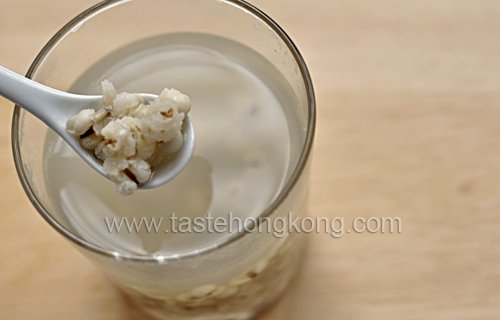
Job's Tears Water or Coix Seeds Water

Putting aside its healing properties, I am also loving this light drink with a subtle nutty flavor. Enjoy!

I shall be happy to share with you more of my posts soon, to get immediate updates and new recipes from here, simply subscribe them via my RSS feeds

You Might also Like

Your Comments

  1. Heavenly Housewife

    I’ve never used this ingredient before, going to keep my eyes out for it now :D
    *kisses* HH

  2. the lacquer spoon

    Interesting name, thanks for the informative post! Yesterday, I made 40 pcs of mini Indian samosa with Japanese gyoza skins cut in half. The stuffing work is often fun, but it drove me mad because of no time before our guests’ arrival. Now wondering this is my version of Job’s Tears ;-)

  3. TasteHongKong

    @lacquer spoon, Wish you turn Tears to Cheers next time. But I bet your guests did appreciate your efforts : ).

  4. Carolyn Jung

    Thanks for the educational primer. I think I’ve had the Job’s Tears, but never known what they were exactly. But then again, many Chinese dishes are like that — filled with unusual textured ingredients that you rarely see elsewhere. ;)

  5. TS of eatingclub vancouver

    I love barley and barley-like things! (That is, other grains.) Yes, those cooked ones look so much like popcorn. Hmm, so it’s “yin”, eh? I think I am too “yang”, so I need more yin foods. The problem is, I really like “yang” foods! I’ll have to try making this drink for me.

  6. Divina

    I’m browsing through quickly through the posts but this one caught my attention. I’ve been looking for this for a long, long time now. I don’t think we have it here. So, I guess when someone goes to HK, I would have to ask them to buy it for me. It has tremendous benefits for the body and I’ve read it’s great for the skin. I think it’s also called hato mugi by Japan. If I use the Chinese word, the people in Chinatown would probably understand me. :) Thanks and great photos.

  7. noobcook

    really love this refreshing drink! I think job’s tears is a beautiful name. Love your photos!

  8. tigerfish

    This is very informative. At least when I see Job Tears or Coix Seeds next time, I will not go “Barley barley!”. You saved me from embarrassment.

  9. Kitchen Butterfly

    OMW (Oh my word), just as I fell in love with your rice milk soup, I’m loving this. I’ve never heard of Job’s tears before so I’ve also learnt a lot, especially with the beautiful visuals that accompany the text. Superb

  10. Mary Moh

    I have seen these at the Chinese shop but don’t really know how to use them. Thanks for sharing the info. I will have to buy and try them as a drink. I love barley drink though. My mom said it’s good for the kidneys.

  11. TasteHongKong

    @TS of eatingclub vancouver, Speaking of the Yin Yan concept, I’m afraid my knowledge is too limited to comment. Yet, as you said and according to Chinese herbalists, our body conditions can be described as Yin / Yan. For foods, so far as I know, they are usually categorized as hot, warm, cool, cold, etc. I must say I lack the information to agree that foods should be related to Yin / Yan (as mentioned in Wikipedia).

    By the way, apart from this drink, let me also suggest for ‘inflammed’ or ‘yang’ bodies green tea and green vegetables which are also healthy foods having the cooling property.

  12. Angie's Recipes

    I love to add in some job’s tears when I make congee.
    You have taken some really good pictures…and thanks for sharing the detailed information about this treasure!

  13. Sook

    Oh what a great post! The drink looks fab, too! Gorgeous pictures as usual. :)

  14. gaga

    I love barley, and I really want to try the others too.

  15. Baking Barrister

    How interesting! I want to try these. Also, I swear the top seed in the cooked photo has little beady eyes that are staring at me!

  16. TasteHongKong

    @gaga, Allow me to repeat, the coix is not suitable for pregnant woman : ).

  17. Linn @ Swedish home cooking

    I’m making a grain-porrige of barley, amaranth, quinoa and oat berries that I eat for breakfast with soy milk. Super yummy and healthy!

  18. Nancy aka Spicie Foodie

    I’ve never seen this grain but it just sounds so wonderful. I love your background and great healthy information on these Job’s tears. I love pearl barley so sounds like I need to hunt for these yummy sounding Job’s tears.

  19. Nancy aka Spicie Foodie

    Congrats your on the top 9 today!!! Hooray!

  20. TasteHongKong

    @Nancy aka Spicie Foodie, Thanks! :) Got some luck today : ).

    And thanks to FB Top9 for choosing this post.

  21. 5 Star Foodie

    I’ve never heard of this, so fascinating to learn!

  22. chandani

    Very interesting and informative. I think we have different name for the grain in Nepal. We use is mostly during our festivals. I forgot the name though.

  23. sophia

    Kenny, my mom used to cook this for me! She made a 5-grain rice with this Job’s Tears, white rice, black rice, millet, and black beans! Oh, and with chestnuts or sweet potato, too! It was so good. The only time I finished my bowl of rice!

  24. food-4tots

    Great post! Although job’s tears are not new to me, it is good to learn more about their health benefits. I only cook pearl barley as my son is not in favour of job’s tears.

  25. TasteHongKong

    @food-4tots, Well this is not a good news : (. I believe kids usually love crispy-fried foods and so this drink should be good for them. I’m thinking if adding of honey and/or lemon juice would help : ).

  26. Kitchen Butterfly

    I found these today in an oriental shop – thanks to you I knew what they were and truly they were labelled pearly barley. I bought a pack!!!!!!!!!

  27. sarah

    This post answered my question today. I went to Park’n’shop for our food and every time I go I try to buy a few things I don’t recognise. I use a book (a visual food dictionary) while I’m there to identify some things but coix seeds weren’t in it. I got them home and found your explanation. Very thorough; thanks.

    I am on the look-out for other HK food bloggers (in English). Do you know any others?

  28. TasteHongKong

    @sarah, Thanks for advising me, I am thrilled to learn that my post solves your query. For HK food bloggers, you may want to check it out from my twitter. I have followed a few who are in H.K., so it should not be difficult for you to pick them out. Enjoy blogging!

Leave a Comment

Thank you for visiting, I would love to hear from you as much as I love to put up posts here ...